
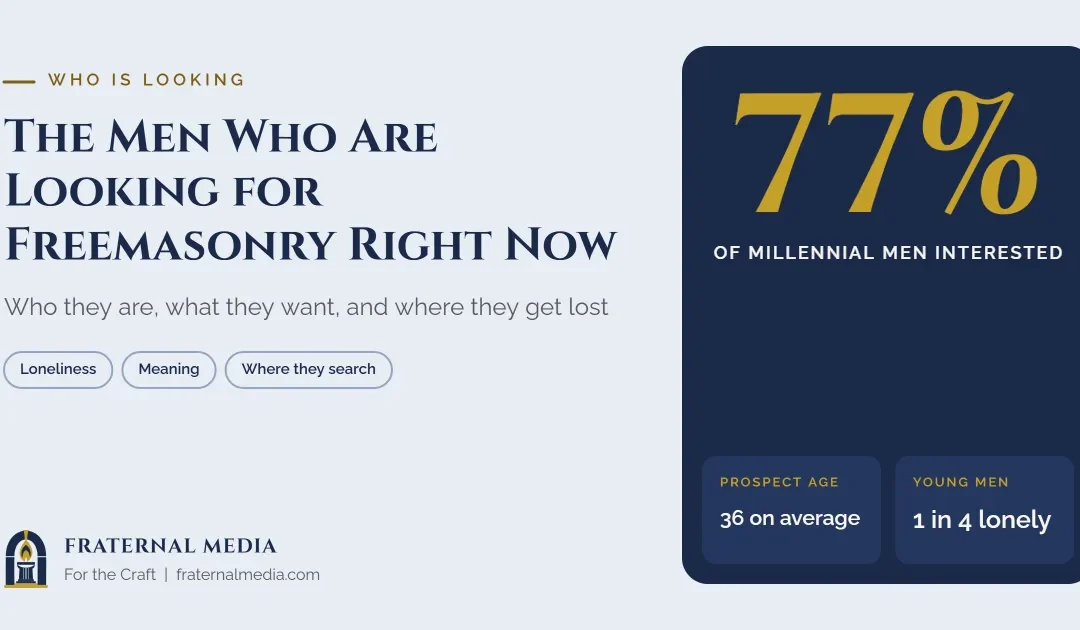
Interest in Freemasonry is real and measurable. Young American men are among the loneliest in the developed world, most say they want deep friendship and a way to become better men, and Scottish Rite research found that 77 percent of millennial men expressed interest in joining once they learned more. The problem is not demand. Most men who reach out online never hear back from a lodge.
He is 31. He moved to your town for work three years ago and still does not have anyone he would call on a bad night. His grandfather wore a ring with a square and compasses, and he has been reading about the fraternity on his phone for months: a few videos, a long thread on Reddit, a question typed into ChatGPT about how a man joins. One evening he fills in a form on a Masonic website. Then he waits.
For most men in his position, nothing happens next. That is not speculation. It is what the fraternity’s own research has found, and it is the most important fact in this post.
Below is what the evidence says about the men looking for Freemasonry right now: who they are, what they want, where they look, and where they get lost.
Who Is Looking
The men most likely to be searching are the ones American life has left most disconnected. The data on this has become hard to ignore.
| Finding | Source |
|---|---|
| 25 percent of US men aged 15 to 34 felt lonely a lot of the previous day, compared with 17 percent of all other US adults and a median of 15 percent for young men across the OECD | Gallup, May 2025 (2023 and 2024 data) |
| The share of men with no close friends rose from 3 percent in 1990 to 15 percent in 2021, and men with at least six close friends fell from 55 percent to 27 percent | Daniel Cox, National Review, reporting Survey Center on American Life data |
| 21 percent of men had received emotional support from a friend in the past week, compared with 41 percent of women | Survey Center on American Life, 2021 |
| Among men aged 18 to 29, 25 percent feel lonely much of the time, 26 percent feel isolated, and 48 percent feel they lack community | Institute for Family Studies and YouGov, August 2026 |
Gallup’s figure is the share who said they felt loneliness “a lot of the previous day,” pooled from 2023 and 2024 surveys.
The cost of that isolation is not abstract. The US Surgeon General’s 2023 advisory warned that “lacking social connection can increase the risk for premature death as much as smoking up to 15 cigarettes a day” (Our Epidemic of Loneliness and Isolation).
The men looking are also younger than many lodges assume. In California, the average age of prospects reaching the Grand Lodge was 36, according to the California Freemason in 2022.
What They Want
When men are asked what they are looking for in an organization, their answers read like a description of a well-run lodge. The Scottish Rite, Northern Masonic Jurisdiction, has surveyed non-Masons twice.
The first three figures are from a 2016 survey of 1,000 non-Masons (Scottish Rite NMJ). The charity figure is from The Path Forward, a 2023 survey of 3,500 American men.
The 2023 research found something else worth noting. Understanding of Freemasonry “has nearly doubled since 2016, increasing from 20% to 39%,” and 91 percent of men identified at least one essential element of Freemasonry as attractive (The Path Forward). Separately, the Scottish Rite reported that 77 percent of millennial men expressed interest in joining once they learned more about it (Millennials and Freemasonry).
Loneliness and a lack of purpose tend to travel together. Harvard’s Making Caring Common project found that “about 75% of lonely adults reported having little or no meaning or purpose” (Loneliness in America 2024). A fraternity built around friendship, self-improvement, and service speaks to both.
Faith, Meaning, and a Note of Caution
You may have read that young men are returning to church in large numbers. The evidence is more mixed than the headlines.
A 2025 Barna and Gloo study reported that “46% of Gen Z men and 55% of Millennial men have attended church in the past week,” compared with 44 percent of Gen Z women and 38 percent of millennial women (Gloo, October 2025). But the Pew Research Center found that the narrowing gender gap “is driven by declining religiousness among American women,” and that “there is no indication that young men are converting to Christianity in large numbers” (Pew, December 2025).
The honest reading is this: young men today are at least as open to faith, ritual, and serious institutions as young women, and a meaningful share of them are actively looking for structure. That openness is the opportunity, whether or not a broad revival is under way.
Where They Look
Almost none of these men will walk past your building and knock. They research on their phones, often for months, across a handful of platforms.
| Where | What the data shows | Source |
|---|---|---|
| AI assistants | 66 percent of adults aged 18 to 29 use AI chatbots, and about four in ten adults use them to search for information | Pew, June 2026 |
| YouTube | Used by 95 percent of adults aged 18 to 29 | Pew Social Media Fact Sheet, 2025 |
| Used by 48 percent of adults aged 18 to 29, and by more men (29 percent) than women (23 percent) | Pew Social Media Fact Sheet, 2025 | |
| Reddit, specifically | The r/freemasonry community has about 106,000 members, up roughly 17,000 in a year | GummySearch, a third-party tracker, September 2026 |
| Grand Lodge websites | California received more than 13,000 new prospects since 2022, nearly all through its online portal | Masons of California, 2024 Fraternity Report |
The Reddit member count comes from a third-party analytics tool rather than Reddit itself, so treat it as an approximation.
The pattern is consistent. Men learn about the craft from videos, discussion forums, and AI assistants, then go looking for a lodge near them. If your lodge is not on the map, not on the web, and not in the answers an assistant gives, it is not part of his search at all. The groundwork for that is covered in Why Your Lodge Doesn’t Show Up on Google and Being Found by AI Assistants.
Where They Get Lost
Here is the most important finding in this post. The Scottish Rite’s BeAFreemason.org portal has sent more than 120,000 leads to Grand Lodges in the United States and Canada, according to its Ohio case study. When it followed up with those men, it found: “Of those men, 83% never heard back from a Lodge or Grand Lodge after submitting an inquiry.” And: “despite the lack of follow-up, 98% of these men surveyed are still interested in becoming a Freemason” (Scottish Rite NMJ).
Where lodges do follow up, the results are encouraging. The Grand Lodge of Ohio sends each lead a nine-week email series and assigns district prospect managers. About 58 percent of its leads become prospects and about 17 percent of prospects become petitioners (Scottish Rite NMJ). In California, about 10 percent of more than 13,000 online prospects have become Masons (Masons of California), and the state reported its first net membership gain in 60 years in 2025.
Is your lodge part of his search? We make lodges findable on Google, on their own websites, and in AI answers, so the men looking can find you and reach you.
What Your Lodge Can Do
The men are already looking. The work is making sure that when one of them reaches for your lodge, he finds something and someone.
- Be on the map. Claim and complete your Google Business Profile, so a man searching nearby finds you.
- Answer every inquiry within days. Name one brother responsible and set up an automatic reply. See The Follow-Up Most Lodges Never Send.
- Check with your Grand Lodge. Ask whether prospects from state or national portals are being routed to your lodge, and who receives them.
- Explain the craft plainly on your site. A page on what Freemasonry is and how a man joins answers the questions he is asking assistants. See What a Lodge Website Actually Needs to Work.
- Show him the lodge is alive. Real photographs of real events on a public page. See What Lodge Social Media Has to Do to Work.
- Invite him to something. A public event or an informal dinner gives a curious man a low-pressure way to meet brothers before he decides anything.
The Man Who Filled in the Form
Somewhere tonight, a man is finishing a long day, opening his phone, and reading about Freemasonry again. He is not looking for a sales pitch. He is looking for evidence that there are still places where men gather to become better, and that one of them might have room for him.
The fraternity’s own research says he is very likely to be ignored. That is the part we can change, one lodge at a time, by being findable and by answering. He has already done the hard part. He asked.
Young American men are unusually lonely, and most say they want friendship, self-improvement, and service, which is what a lodge offers.
They research Freemasonry online, on YouTube, Reddit, AI assistants, and Grand Lodge portals, long before they contact anyone.
Scottish Rite research found 83 percent of online inquirers never heard back. Answering them is the single biggest opportunity a lodge has.
Questions Brothers Ask
Are young men actually interested in Freemasonry?
The evidence says yes. Scottish Rite research found that 77 percent of millennial men expressed interest in joining once they learned more, and the Grand Lodge of California has received more than 13,000 online prospects since 2022. Understanding of Freemasonry among American men nearly doubled between 2016 and 2023.
Why are men drawn to Freemasonry now?
Many are lonely and looking for structure. Gallup found that 25 percent of US men aged 15 to 34 felt lonely a lot of the previous day, and men with no close friends rose from 3 percent in 1990 to 15 percent in 2021. Surveys show most men want deep friendships and an organization that helps them become better men.
How do men find a lodge today?
Mostly online. They learn about the craft on YouTube, Reddit, and AI assistants, then search for a lodge nearby or inquire through a Grand Lodge or national portal. A lodge that is not findable on Google, on its own website, and in AI answers is missing from that search.
What happens to men who inquire online?
Too often, nothing. Scottish Rite research found that 83 percent of men who inquired through BeAFreemason.org never heard back, yet 98 percent were still interested. In California, nearly 45 percent of lodges had not contacted the prospects sent to them.
Are young men returning to religion too?
The evidence is mixed. A 2025 Barna and Gloo study found Gen Z men slightly more likely than Gen Z women to have attended church in the past week. Pew Research found the gap is narrowing mainly because women are becoming less religious, and sees no sign of large-scale conversion among young men.
What should a lodge do first?
Make sure every inquiry is answered within days by a named brother, and that the lodge can be found on Google. Then ask your Grand Lodge whether prospects from its portal are reaching your lodge, and who receives them.
Sources
- Gallup, Younger Men in the U.S. Among the Loneliest in West, May 20, 2025.
- Survey Center on American Life, The State of American Friendship: Change, Challenges, and Loss, June 8, 2021.
- Daniel Cox, American Men Suffer a Friendship Recession, National Review, July 2021.
- Institute for Family Studies, Demoralized but Not Defeated: What 2,000 Young Men Told IFS About Their Lives, August 5, 2026.
- US Surgeon General, Our Epidemic of Loneliness and Isolation, 2023.
- Harvard Graduate School of Education, Making Caring Common, Loneliness in America 2024.
- Scottish Rite, NMJ, The Path Forward, 2023 research.
- Scottish Rite, NMJ, Promoting Freemasonry Throughout North America, 2016 survey.
- Scottish Rite, NMJ, Millennials and Freemasonry.
- Scottish Rite, NMJ, Grand Lodge of Ohio growth case study.
- Gloo, New Study Shows Men Now Surpass Women in Church Attendance, October 7, 2025.
- Pew Research Center, Religion Holds Steady in America, December 8, 2025.
- Pew Research Center, Americans and AI 2026, June 17, 2026.
- Pew Research Center, Social Media Fact Sheet, November 2025.
- GummySearch, r/freemasonry community statistics, September 30, 2026.
- Masons of California, 2024 Fraternity Report: Doors Open.
- Masons of California, The Leader, November 2023.
- California Freemason, At the Masonic Lodge, Gen Z Is in Charge Now, December 12, 2022.
- Masons of California, 2025 Fraternity Report.
Be There When He Asks
We make lodges findable where men are searching and help them answer every inquiry. If you want your lodge to be the one that responds, we should talk.