
The Highlands Masonic Temple in Denver shows how a lodge-operated venue keeps a historic building standing and the lodge meeting inside it. Built in 1927 and designed by the architect brothers Merrill and Burnham Hoyt, the temple is owned and operated by Highlands Temple Lodge No. 86 and runs as Highlands Event Center, hosting weddings, galas, and gatherings of up to 400 guests. The venue is not a distraction from the lodge. It is how a building made for a much larger membership stays open for the next one.
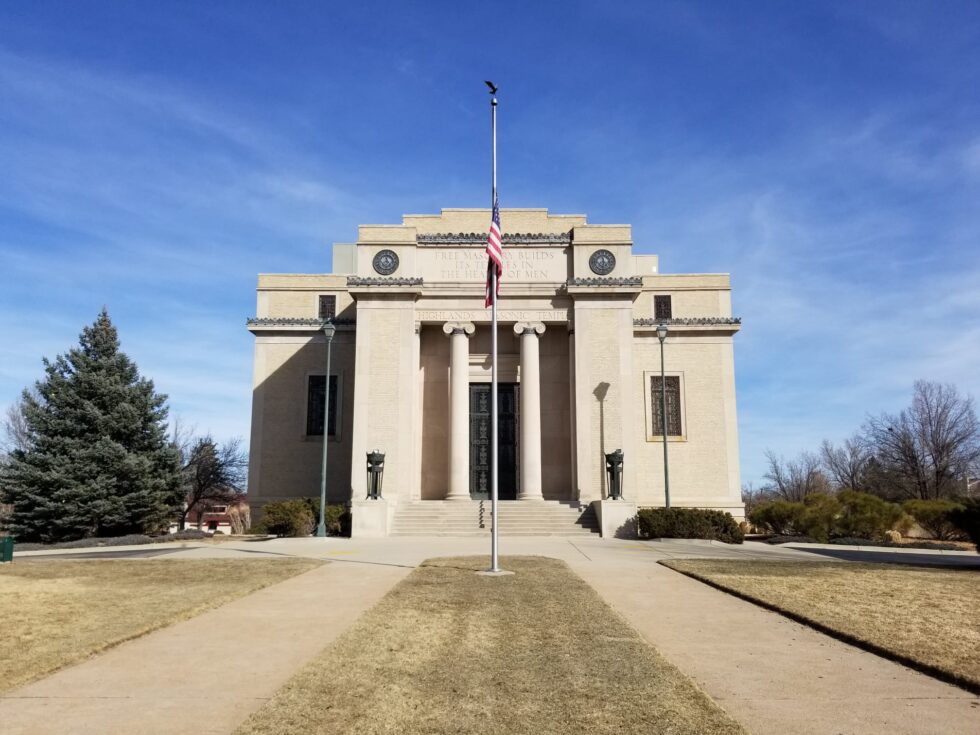
Drive up Federal Boulevard northwest of downtown Denver and you will pass a pale stone temple with Ionic columns and a flagpole, on a lot that fills a city block. It is the largest building in the Highland neighborhood. Masons still meet there. On a Saturday, there may be a wedding in the ballroom.
That combination is not an accident or a compromise. It is a deliberate answer to a question every lodge with a large building eventually faces: how do you keep a temple built for one era of the fraternity open in another?
This is also my own lodge, and Fraternal Media built the event center’s website, so I know it well. Here is its story, what keeps it open, and what other lodges can take from it.
A Temple Built for a Neighborhood
The lodge, now Highlands Temple Lodge No. 86, did not start in this building. According to the Denver Architecture Foundation, the lodge “originally met in another historic building at 3220 North Federal Boulevard” before building its current home in 1927 (Denver Architecture Foundation). That earlier hall, a two-story Neo-Classical Revival building from 1905, was listed on the National Register of Historic Places in 1995 (History Colorado).
For its new temple, the lodge turned to two architects who had grown up nearby. Merrill and Burnham Hoyt were brothers raised in north Denver who both graduated from North High School. Their firm “prospered in the 1920s and is credited with the design of many of Denver’s iconic buildings of the era,” and Burnham later became dean of the School of Architecture at New York University, according to the Denver Architecture Foundation.
They designed the temple in the Classical Greek Revival style. The foundation describes “original chandeliers and lighting, classical art deco ceilings, a bust of President and Freemason George Washington, a grand ballroom, square and compass designs in the floor work and original door knobs throughout the building.”
What It Takes to Keep a Building Like This
A temple on a full city block is expensive in ways a small lodge hall is not. The roof, the heating plant, the elevators, insurance, and decades-old plaster and woodwork all need attention, and none of it waits for a good membership year.
The lodge does not publish its operating budget, but other temples give a sense of scale. Detroit’s much larger Masonic Temple reported “an operating cost of $1.2 million a year” (Detroit Metro Times, 2014). A smaller temple in Flint, Michigan, cost “about $120,000 a year to keep the doors open,” and its members said plainly that “our income is less than our expenses” (East Village Magazine, 2017).
Buildings like these were sized for the fraternity at its largest. As covered in Masonic Temples and the Buildings That Built America, many lodges in that position have sold. Dues from today’s membership rarely cover a building designed for several times as many members.
How the Venue Pays Its Way
The answer in the Highlands was to open the doors. The Denver Architecture Foundation notes that the temple “is now also used as a place for public and private events such as festivals and weddings, and hosts many Masonic groups such as El Jebel Shriners.” The event center’s own description says the building “is owned and operated by Highlands Temple Lodge No. 86, whose stewardship has kept this remarkable structure in active use for nearly a century” (Highlands Event Center).
| What the venue offers | Details |
|---|---|
| Capacity | Up to 400 guests, with layouts from intimate dinners to galas |
| Signature spaces | A hardwood ballroom, a grand staircase, vintage chandeliers, and soaring ceilings |
| Events | Weddings, corporate events, proms, quinceañeras, holiday parties, dinners, and celebrations of life |
| Services | In-house catering, audio and visual equipment, tables and chairs, on-site staff, and an event planner |
| Access | Free on-site parking on a full city block, elevators, and accessible restrooms |
Details from the Highlands Event Center website.
Notice what is in that list. The venue sells what the building already has: a ballroom, a staircase, history, and room to park. The same features that made the temple impressive in 1927 are what a couple planning a wedding or a company planning a gala is looking for now.
Why the Venue Is the Lodge’s Future
It would be easy to see the event center as a necessary evil, a way to pay the bills while the real work of the lodge happens upstairs. I see it the other way around.
First, the venue keeps the lodge in its home. Without event revenue, a building this size would face the choice so many temples have faced. Second, it brings thousands of guests through the doors who would otherwise never set foot in a Masonic building. Every wedding guest who admires the ballroom learns, at least a little, that Freemasons built something beautiful and still care for it. Third, it gives the lodge a public role in its neighborhood again, which is where Masonic halls began.
Other lodges have reached the same conclusion. Traverse City Masonic Lodge #222 in Michigan relaunched its hall as an event space for up to 140 guests in 2026, with the income meant to support its charitable work (The Ticker). In Ohio, the masons of East Liverpool used a “$3.5 million endowment to start renovating the landmark building in 2018” so it could serve as a venue for the city (Business Journal Daily).
Even where a temple has been sold, the value of its rooms is recognized: the new owner of the former Masonic temple in St. Louis kept the temple room intact and made it available for events (St. Louis Magazine).
Does your lodge have a building worth booking? We build venue websites, Business Profiles, and booking inquiry systems for lodge-operated halls and temples, with the lodge holding every key.
What Other Lodges Can Learn
Not every lodge has a temple on a city block. But any lodge with a hall worth renting can borrow the principles that keep the Highlands open.
- Give the venue its own identity. Highlands Event Center has its own name, website, phone number, and inquiry path, separate from the lodge. The how-to is in Your Lodge and Your Venue Need Separate Websites.
- Sell what the building already has. The ballroom, the staircase, the chandeliers, and the parking are the product. Show them in good photographs.
- Treat bookings as a business. In-house catering, an event planner, and fast replies are what let a historic building compete with hotels. Planners compare several venues at once, as covered in Getting Your Venue in Front of the People Booking Events.
- Invest in the building’s character. When the ballroom floor needed replacing, it was rebuilt in maple to match the original. The history is the reason people book.
- Keep the lodge at the center. The venue exists to serve the lodge and the building. Lodge rooms and anything touching the lodge’s private work stay out of the marketing.
A Building Worth Keeping
The brothers of Lodge No. 86 who built this temple in 1927 could not have imagined Instagram wedding photos on their staircase or a corporate gala in their ballroom. They did imagine that the building would outlast them and keep serving the lodge and the neighborhood.
Nearly a century later, it does both. That is what lodge venues do at their best. They do not replace the craft. They keep a home for it, so that when the next generation of men comes looking for a lodge, the doors on Federal Boulevard are still open.
The Highlands Masonic Temple, built in 1927 by the Hoyt brothers, is owned and operated by Highlands Temple Lodge No. 86.
As Highlands Event Center, it hosts weddings, galas, and gatherings of up to 400 guests, which helps keep a building sized for a much larger fraternity open.
Any lodge with a hall worth renting can borrow the approach: a separate venue identity, a professional booking operation, and pride in the building’s history.
Questions Brothers Ask
What is the Highlands Masonic Temple?
It is a 1927 Classical Greek Revival temple at 3550 Federal Boulevard in Denver’s Highland neighborhood, designed by the brothers Merrill and Burnham Hoyt. It is owned and operated by Highlands Temple Lodge No. 86 and is the largest building in the neighborhood.
Can the public rent the Highlands Masonic Temple?
Yes. It operates as Highlands Event Center, hosting weddings, corporate events, proms, holiday parties, and other gatherings of up to 400 guests, with in-house catering and free on-site parking.
Who designed the Highlands Masonic Temple?
Merrill and Burnham Hoyt, brothers who grew up in north Denver. Their firm designed many of Denver’s notable buildings of the 1920s, and Burnham Hoyt later became dean of the School of Architecture at New York University.
How do event venues help Masonic lodges?
Large temples were built for a much bigger fraternity, and dues alone rarely cover their upkeep. Renting the building for weddings and events brings in revenue to maintain it, introduces the public to the building, and lets the lodge keep meeting in its historic home.
Does renting the building affect the lodge?
Not when it is run well. A lodge venue works best with its own name, staff or coordinator, and booking process, while lodge meetings continue on their own schedule and lodge rooms and private work stay out of the venue’s marketing.
Can a smaller lodge do the same thing?
Often, yes. A lodge with a hall worth renting can start with its own venue name and website, good photographs, clear capacity and pricing guidance, and fast replies to inquiries. Traverse City Lodge #222 in Michigan relaunched its hall as an event space for up to 140 guests.
Sources
- Denver Architecture Foundation, Highlands Masonic Temple.
- Margaret Jackson, Historic Masonic Center, Largest Building in Highland, Gets a New Floor, Westword, May 18, 2017.
- Highlands Event Center of Denver, home page and About.
- History Colorado, Highlands Masonic Lodge, National and State Register.
- National Park Service, National Register nomination, Highlands Masonic Lodge, 3220 Federal Boulevard.
- Detroit Metro Times, A tour of Detroit’s enormous Masonic Temple, October 22, 2014.
- East Village Magazine, Masonic Temple future uncertain as membership, income decline, February 3, 2017.
- The Ticker, Value Venue: Local Masonic Lodge Launches New Events Program, February 8, 2026.
- Business Journal Daily, East Liverpool Masonic Temple renovation, May 21, 2024.
- Sarah Fenske, Midtown’s Masonic temple is now a bustling apartment complex, St. Louis Magazine, November 11, 2024.
- The Knot Worldwide, 2026 Real Weddings Study data readout.
Keep Your Building Open
We help lodges turn historic halls and temples into venues people want to book, so the building pays its way and the lodge keeps its home. If your lodge’s building could do more, we should talk.