
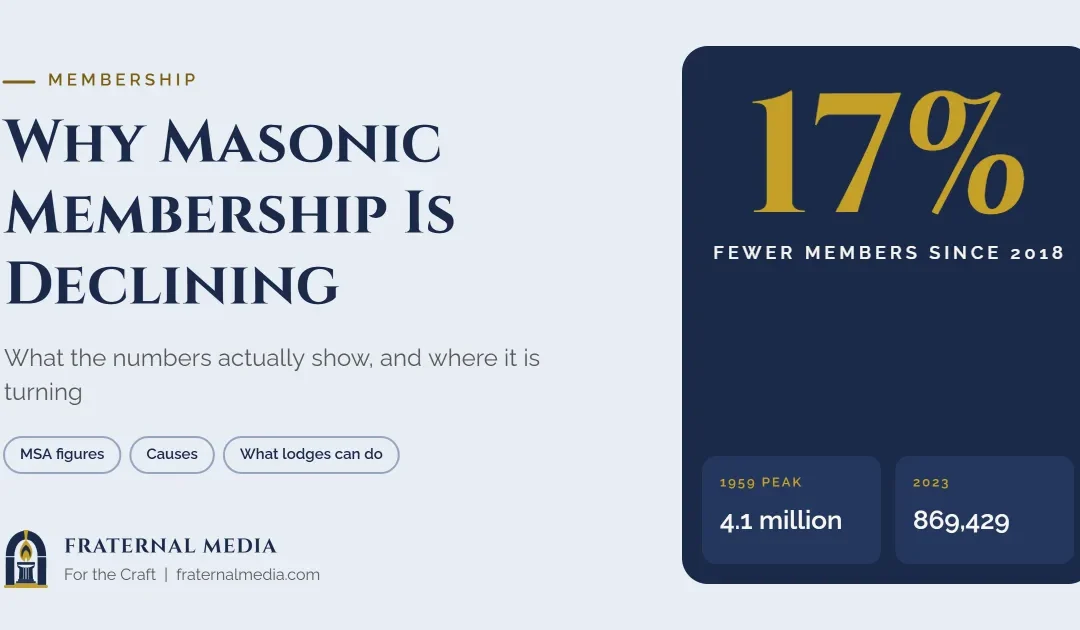
Masonic membership in the United States has fallen from about 4.1 million in 1959 to 869,429 in 2023, and it has dropped every year in the most recent published figures. The causes are an aging membership, the long decline of American civic life, men drifting away after joining, and inquiries that lodges never answer. The decline is not proof that men have stopped wanting what the craft offers, and the jurisdictions acting on that are starting to turn it around.
Most of us have sat through the report. The Secretary reads the year’s figures at the annual meeting: so many raised, so many affiliated, and then the longer list of brothers lost to death, demits, and suspensions. The second number is larger than the first, as it was last year and the year before. Someone mentions that the lodge once had 600 members. Nobody says much after that.
It is easy to treat the decline as weather, something that happens to the fraternity rather than something it can respond to. The evidence does not support that view. The losses have specific causes, several of them within a lodge’s control, and the places that have addressed them are reporting results.
Below are the numbers without softening, the reasons behind them as far as the research shows, and what the jurisdictions seeing improvement are actually doing.
The Numbers, Plainly
The Masonic Service Association of North America publishes membership totals reported by each Grand Lodge. Its most recent table covers 2018 through 2023, and every year is lower than the one before.
| Year | US members | Change from prior year |
|---|---|---|
| 2018 | 1,046,846 | Not shown |
| 2019 | 1,010,150 | Down 36,696 |
| 2020 | 942,195 | Down 67,955 |
| 2021 | 919,129 | Down 23,066 |
| 2022 | 881,219 | Down 37,910 |
| 2023 | 869,429 | Down 11,790 |
Totals from the MSA jurisdictional membership statistics. Annual changes are our arithmetic. MSA notes that “each Grand Lodge uses different metrics to determine who should be counted,” so treat the totals as close approximations.
Over those five years the fraternity lost 177,417 members, about 17 percent. The largest jurisdictions show the same pattern. Pennsylvania went from 95,991 to 76,313 and Ohio from 77,449 to 61,746 over the same period, according to the same MSA table.
How Far From the Peak
The longer view is starker. NPR, reporting in 2020, put it this way: “membership has dropped roughly 75% from a high of more than 4.1 million in 1959,” a year “when about 4.5% of all American men were members” (NPR).
Figures for 1959 to 2010 are Masonic Service Association records as reproduced in the appendix to Alain de Keghel’s American Freemasonry and in the Phoenixmasonry membership table. The 2023 figure is from MSA directly. Some researchers place the peak in 1960 rather than 1959.
By our arithmetic from those figures, membership in 2023 stood about 79 percent below its peak. Put another way, for every five Masons in 1959, roughly one remains.
Why It Happened
No single cause explains a decline this long. The research points to several forces acting at once, most of them affecting far more than Freemasonry.
American civic life shrank around the lodge
Freemasonry’s decline is part of a much wider retreat from organized community life. Robert Putnam documented it in Bowling Alone (2000), which grew out of a 1995 essay. In that essay he listed declines among fraternal groups, including the Elks, the Shriners, the Jaycees, and “the Masons (down 39 percent since 1959),” as quoted in a Rogers State University summary of his work.
Other institutions show the same curve. Gallup found that in 2020, “47% of Americans said they belonged to a church, synagogue or mosque, down from 50% in 2018 and 70% in 1999,” and from 73 percent when it first measured in 1937 (Gallup). Research from Iowa State University found that membership in fraternal organizations in the state’s small towns “over the last 30 years has fallen by over two-thirds” (Iowa Small Towns Project).
Americans became more isolated
As those institutions weakened, so did the habits of friendship that sustained them. The US Surgeon General’s 2023 advisory, Our Epidemic of Loneliness and Isolation, reports that time spent in person with friends fell from 60 minutes a day in 2003 to 20 minutes a day in 2020. It also found that in 2018, “only 16% of Americans reported that they felt very attached to their local community.”
Men’s friendships shrank faster than most. The Survey Center on American Life found that 12 percent of Americans had no close friends in 2021, compared with 3 percent in 1990 (Survey Center on American Life). Among men, the center’s director, Daniel Cox, reported that “the percentage of men without any close friends jumped from 3 percent to 15 percent” (National Review).
The postwar generation aged
The peak of 1959 was built on an unusually large cohort of men. As that generation aged, deaths alone guaranteed steady losses for decades, and recruitment never replaced them. Deaths remain one of the three largest sources of loss, as the next section shows.
The Losses From Within
Deaths are unavoidable. The other losses are not, and the Grand Lodges that have studied them are blunt about it.
The Grand Lodge of Virginia’s 2009 membership retention tool kit names them directly: “Our three biggest contributors to membership decline are deaths, demits, and suspension for non-payment of dues.” It also observes that “the typical Mason becomes inactive quickly, in about four years.”
| Finding | Source |
|---|---|
| Suspensions for non-payment in California spiked during the pandemic, at more than 1,400 in 2022 | Masons of California, 2022 Fraternity Report |
| Three out of four suspended California Masons cited financial distress as the leading cause | The Leader, February 2023 |
| In a Kentucky study, 56 percent of men on lodge rolls had never meaningfully participated since their most recent degree | William O. Ware Lodge of Research, 2019 |
| In the same Kentucky survey of 476 members, 96 percent wanted consistent communication from their lodge | William O. Ware Lodge of Research, 2019 |
| “Quality and Masonic focus in programming remains the single most important factor when it comes to membership retention” | Grand Lodge of New York, Membership Development Committee |
Retention research from individual Grand Lodges and lodges of research. National breakdowns of losses by cause are not published.
Read together, these point to something uncomfortable. Many men join, find that their lodge offers them little, and quietly stop coming. Some years later the dues notice arrives, nobody calls, and the suspension follows. The man was lost long before the paperwork caught up.
What the Decline Is Not
It would be easy to read the numbers as evidence that men no longer want fraternity. The research says otherwise.
The Scottish Rite, Northern Masonic Jurisdiction, has run the BeAFreemason.org inquiry portal since 2020. In its review of what happened to those inquiries, it found: “Of those men, 83% never heard back from a Lodge or Grand Lodge after submitting an inquiry.” It added that “despite the lack of follow-up, 98% of these men surveyed are still interested in becoming a Freemason” (Scottish Rite NMJ). The same research found that 77 percent of millennial men expressed interest in joining once they learned more about it.
California’s experience matches. Its Grand Lodge reported that nearly 45 percent of lodges had not contacted the qualified prospects sent to them, “leaving 2,400 prospects uncontacted” (The Leader, November 2023).
Men inquire in large numbers, mostly online, and most of those who are ignored remain interested.
A large share of inquiries are never answered. Each one is a man who wanted to join and was turned away by silence.
Loneliness among men is part of why the interest exists. Gallup reported in 2025 that young American men are among the loneliest in the developed world, with 25 percent of US men aged 15 to 34 saying they felt lonely a lot of the previous day (Gallup). Freemasonry offers exactly what that statistic says they lack.
Where It Is Turning
The clearest evidence that the decline can be reversed comes from California, which acted on several of the problems above at once.
Ohio offers a second model. According to a Scottish Rite NMJ case study, the Grand Lodge of Ohio sends each new lead a nine-week email series and assigns district prospect managers to follow up personally. About 58 percent of its leads become prospects, and about 17 percent of prospects become petitioners.
Neither approach is complicated. Both come down to answering the men who ask, and keeping the men who join.
Want your lodge on the right side of these numbers? We make lodges findable on Google and set up inquiry follow-up so no man who asks goes unanswered.
What a Single Lodge Can Do This Year
A lodge cannot reverse national demographics. It can stop losing the men who are already reaching for it.
- Answer every inquiry within days. Name one brother responsible and send an automatic acknowledgment. The full approach is in The Follow-Up Most Lodges Never Send.
- Be findable where men look. Claim and complete the Google Business Profile and make sure your website does its job.
- Call the brothers who have drifted. Before the dues notice, not after the suspension. A phone call from a friend reaches men a letter does not.
- Give the men who join a reason to stay. The New York and Kentucky findings point the same way: good programming and steady communication keep men coming back.
- Treat financial hardship with discretion. California found that most suspended members were in financial distress. A quiet conversation can keep a brother on the rolls.
The Men Who Kept the Light On
Every lodge that is still meeting today exists because, at some low point in its history, a handful of brothers decided it was worth keeping. They paid the bills when the dues did not cover them. They showed up when attendance was thin. They wrote the letter to the brother who had stopped coming.
The numbers in this post are real, and they are discouraging. But they are not the whole story. Thousands of men are asking, every year, how to find a lodge. Whether the decline continues depends less on them than on whether someone answers.
US membership has fallen from about 4.1 million in 1959 to 869,429 in 2023, and it fell every year from 2018 to 2023.
Civic decline and isolation set the backdrop, but lodges also lose men through inactivity, suspensions, and unanswered inquiries.
Where Grand Lodges answered inquiries and restored lapsed members, as in California, membership has started to grow again.
Questions Brothers Ask
How many Freemasons are there in the United States?
The Masonic Service Association reported 869,429 members across US Grand Lodges in 2023, its most recent published total. Grand Lodges count members in slightly different ways, so the figure is a close approximation rather than an exact count.
When was Masonic membership at its peak?
US membership peaked at about 4.1 million in 1959, according to Masonic Service Association records, when about 4.5 percent of American men were members. Some researchers place the peak in 1960.
Why is Masonic membership declining?
The main causes are the aging of the large postwar generation, a broad decline in American civic and religious membership, rising social isolation, and losses within lodges through inactivity, demits, and suspension for non-payment of dues. Unanswered inquiries add to it.
Are young men still interested in Freemasonry?
Yes. Scottish Rite research found that 77 percent of millennial men expressed interest in joining once they learned more, and that 98 percent of men whose inquiries went unanswered were still interested. California has received more than 13,000 online prospects since 2022.
Is any jurisdiction growing?
California reported in its 2025 Fraternity Report that statewide membership grew by 647 brothers, its first increase in 60 years. Its Grand Lodge has focused on restoring suspended members and following up with online prospects.
What is the single most useful thing a lodge can do?
Answer every inquiry promptly. Scottish Rite research found that 83 percent of men who inquired online never heard back. A lodge that responds within days, with a named brother following up, keeps men that most lodges lose without knowing it.
Sources
- Masonic Service Association of North America, Jurisdictional Masonic Membership Statistics, 2018 to 2023.
- NPR, Freemasons Say They’re Needed Now More Than Ever. So Why Are Their Ranks Dwindling?, November 28, 2020.
- Alain de Keghel, American Freemasonry, Appendix I, reproducing MSA records.
- Phoenixmasonry, Masonic Membership Statistics, reproducing MSA records.
- Gallup, U.S. Church Membership Falls Below Majority for First Time, March 29, 2021.
- Rogers State University, summary of Robert Putnam’s work on civic decline.
- Iowa State University, Research finds big drop in service club membership in Iowa towns, December 3, 2024.
- US Surgeon General, Our Epidemic of Loneliness and Isolation, 2023.
- Survey Center on American Life, The State of American Friendship, June 8, 2021.
- Daniel Cox, American Men Suffer a Friendship Recession, National Review, July 2021.
- Gallup, Younger Men in the U.S. Among the Loneliest in West, May 20, 2025.
- Grand Lodge of Virginia, 2009 Membership Retention Tool Kit.
- William O. Ware Lodge of Research, Characteristics of an Ideal Lodge: Survey Results and Analysis, October 1, 2019.
- Grand Lodge of New York, Membership Development Committee report.
- Scottish Rite, NMJ, Millennials and Freemasonry.
- Scottish Rite, NMJ, Grand Lodge of Ohio growth case study.
- Masons of California, 2022 Fraternity Report.
- Masons of California, The Leader, February 2023: Restoring Suspended Members.
- Masons of California, The Leader, November 2023.
- Masons of California, 2024 Fraternity Report: Doors Open.
- Masons of California, 2025 Fraternity Report.
Stop Losing the Men Who Ask
We help lodges become findable, answer every inquiry, and stay in touch with their members. If your lodge wants to be part of the turnaround, we should talk.